Series/Parallel Resistors · Equivalent Resistance, Voltage and Current Division
Switch between Series/Parallel mode, adjust two resistor values, and view equivalent resistance with voltage/current division ratios
Circuit Parameters
R₁ and R₂ in series, same current, voltage divided proportionally by resistance
Equivalent Resistance Formula
Voltage/Current Division Results
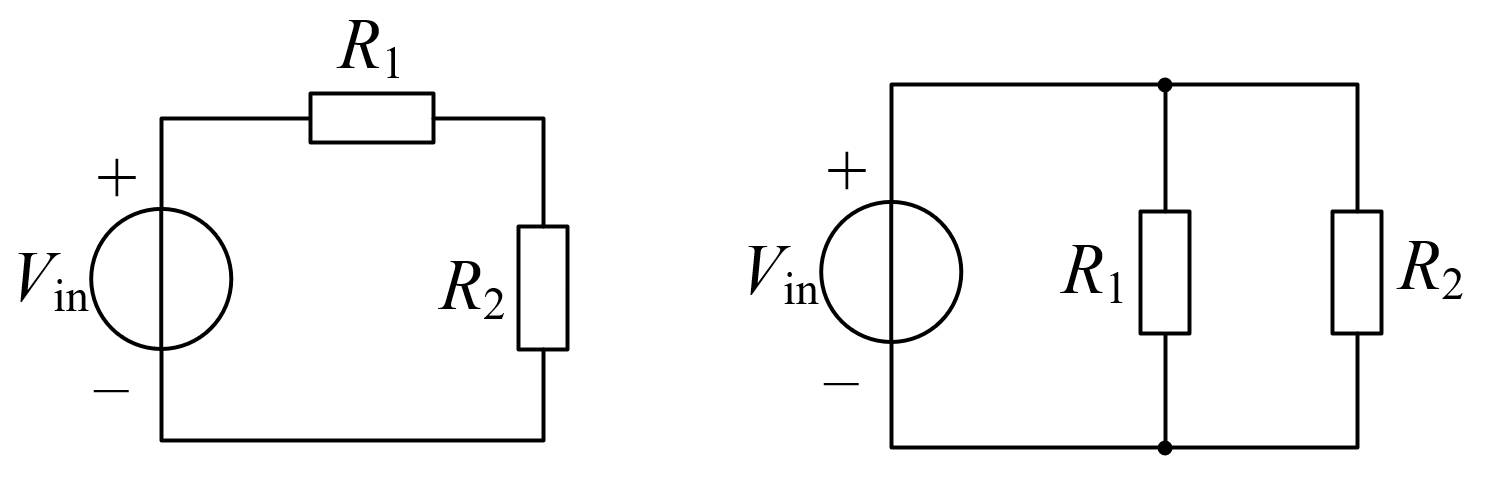
Theoretical Basis
Series voltage division: \(U_1 = U_{in} \cdot \dfrac{R_1}{R_1+R_2}\), \(U_2 = U_{in} \cdot \dfrac{R_2}{R_1+R_2}\).
The same current flows through both resistors: \(I = U_{in} / (R_1+R_2)\).
The voltage ratio equals the resistance ratio: \(U_1/U_2 = R_1/R_2\).
Characteristic Interpretation
• When \(R_1 = R_2\), voltage (series) or current (parallel) is split equally.
• Series: When \(R_1 \gg R_2\), \(U_1 \approx U_{in}\) and \(R_2\) has a very small voltage share.
• Parallel: When \(R_1 \gg R_2\), \(I_2 \gg I_1\) and most current flows through the smaller resistor.
• Equivalent resistance: Series \(R_{eq} \approx \max(R_1, R_2)\), Parallel \(R_{eq} \approx \min(R_1, R_2)\).