Wheatstone Bridge · Balance Condition and Sensitivity
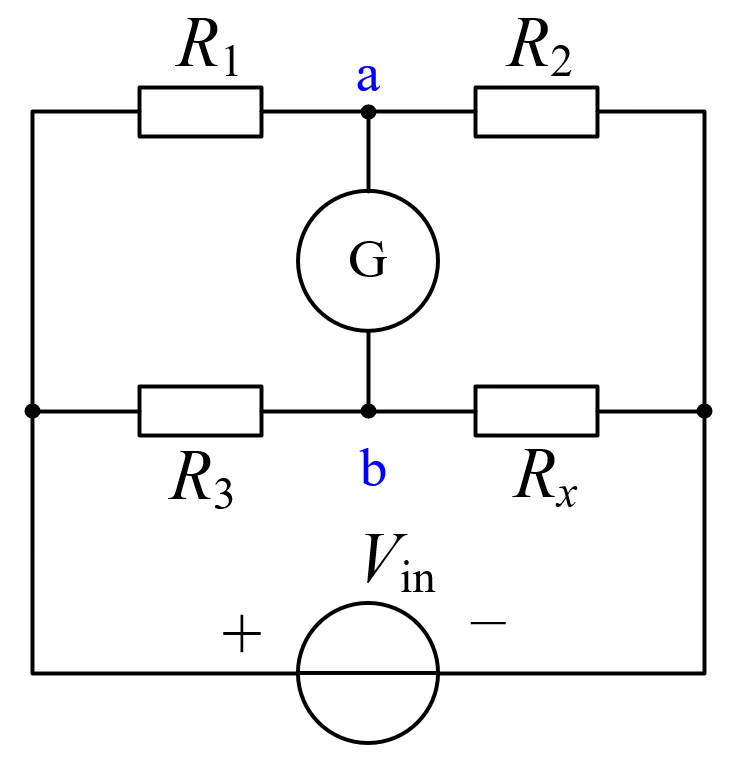
Classic bridge circuit | Adjust the bridge-arm resistors to observe the galvanometer current | Balance condition \(R_1/R_2 = R_3/R_x\)
\(U_{in} = 10\text{V}\) (fixed) | Galvanometer internal resistance \(R_G = 100\,\Omega\)
Bridge Arm Resistance Settings
Fixed DC voltage source
Wheatstone Bridge Topology
\(U_G = U_a - U_b\) \(I_G = U_G / R_G\)
Bridge Midpoint Voltages \(U_a\) and \(U_b\)
Galvanometer Indicator · Current \(I_G\)
Bridge Arm Voltage and Galvanometer
Balance Status
Wheatstone Bridge Balance Principle
When the bridge arm resistors satisfy \(R_1/R_2 = R_3/R_x\) (i.e., \(R_1 R_x = R_2 R_3\)), the galvanometer voltage \(U_G = 0\) and the bridge is balanced. At this point \(U_a = U_b\) and no current flows through the galvanometer. Adjust all four bridge-arm resistors independently to see how the circuit reaches, or departs from, balance. At balance, \(R_x = R_2 R_3 / R_1\), which can be used for precise measurement of an unknown resistance.
Sensitivity and Galvanometer
Galvanometer internal resistance \(R_G = 100\,\Omega\), used to detect small imbalance currents. Bridge sensitivity depends on the galvanometer's current detection capability and the bridge arm resistance values. When \(U_G\) is near zero, the galvanometer needle is centered; away from balance, the current direction indicates the relative magnitudes of \(U_a\) and \(U_b\). Click the "Auto Balance" button to automatically adjust \(R_x\) to the balance value.